The 4 Pillars of Safe Transport®
The proven framework used by transport operators to manage risk, strengthen compliance and improve safety performance.
Why We Created the 4 Pillars of Safe Transport®
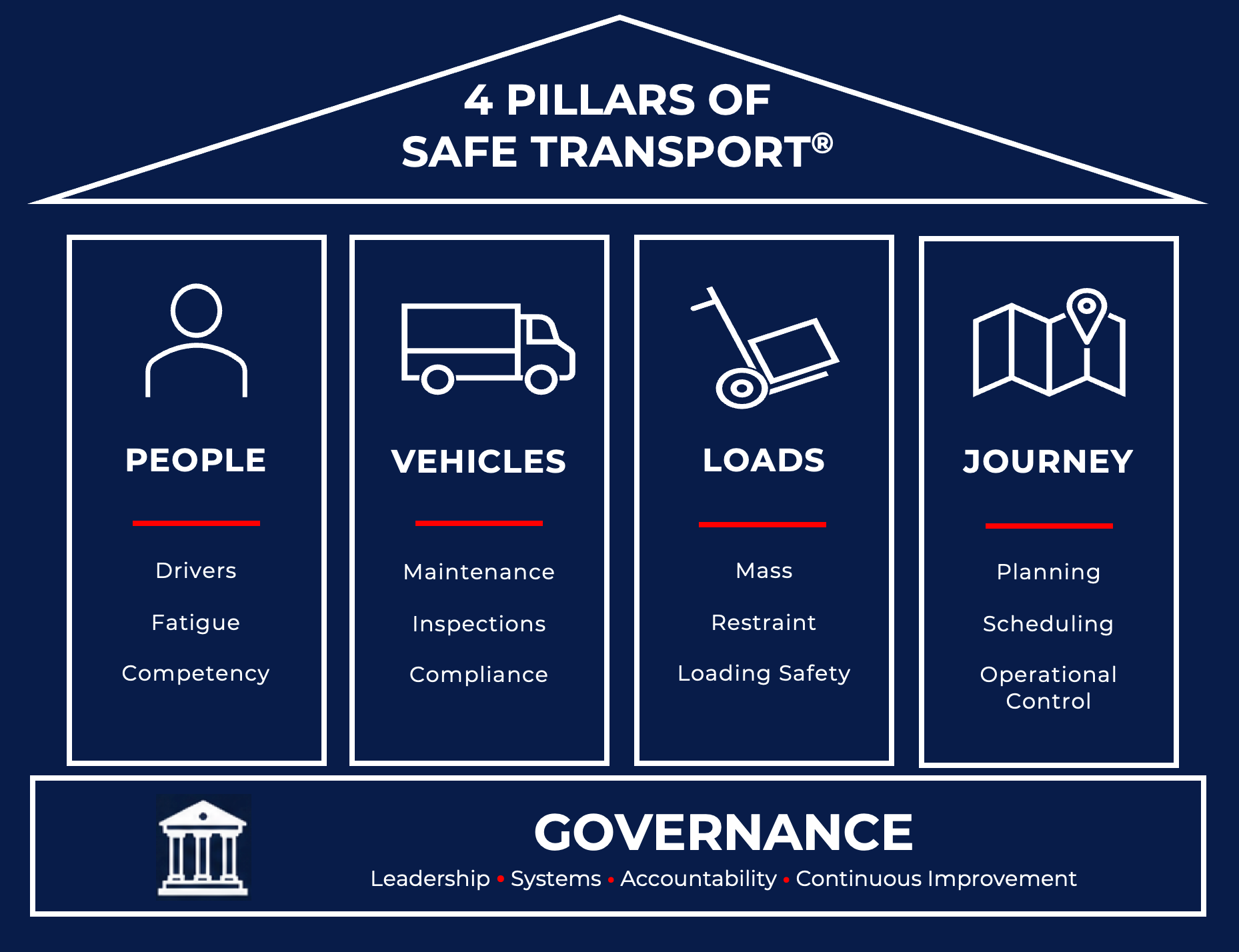
We saw the difficulty operators and their supply chain partners faced trying to keep track of all the elements of Chain of Responsibility — mass, maintenance, fatigue, speed, vehicle standards, load restraint, executive duties, and thousands of pages of legislation that nobody has time to read.
When you've got a business to run, trucks to move and customers to service, it can feel overwhelming.
The 4 Pillars of Safe Transport® was developed to simplify transport safety and compliance into a practical framework that operators, managers and supply chain partners alike can understand, implement and manage every day.
By focusing on People, Vehicles, Loads and Journeys, supported by strong Governance, businesses can identify risk earlier, strengthen compliance, and build safer, more resilient transport operations.

Compliance doesn’t need to be complicated
Transport businesses are often expected to understand fatigue, speed, mass, dimension, loading, maintenance, vehicle standards, fitness for work, training, scheduling and countless other compliance requirements.
While each of these obligations is important, explaining them individually can quickly become overwhelming.
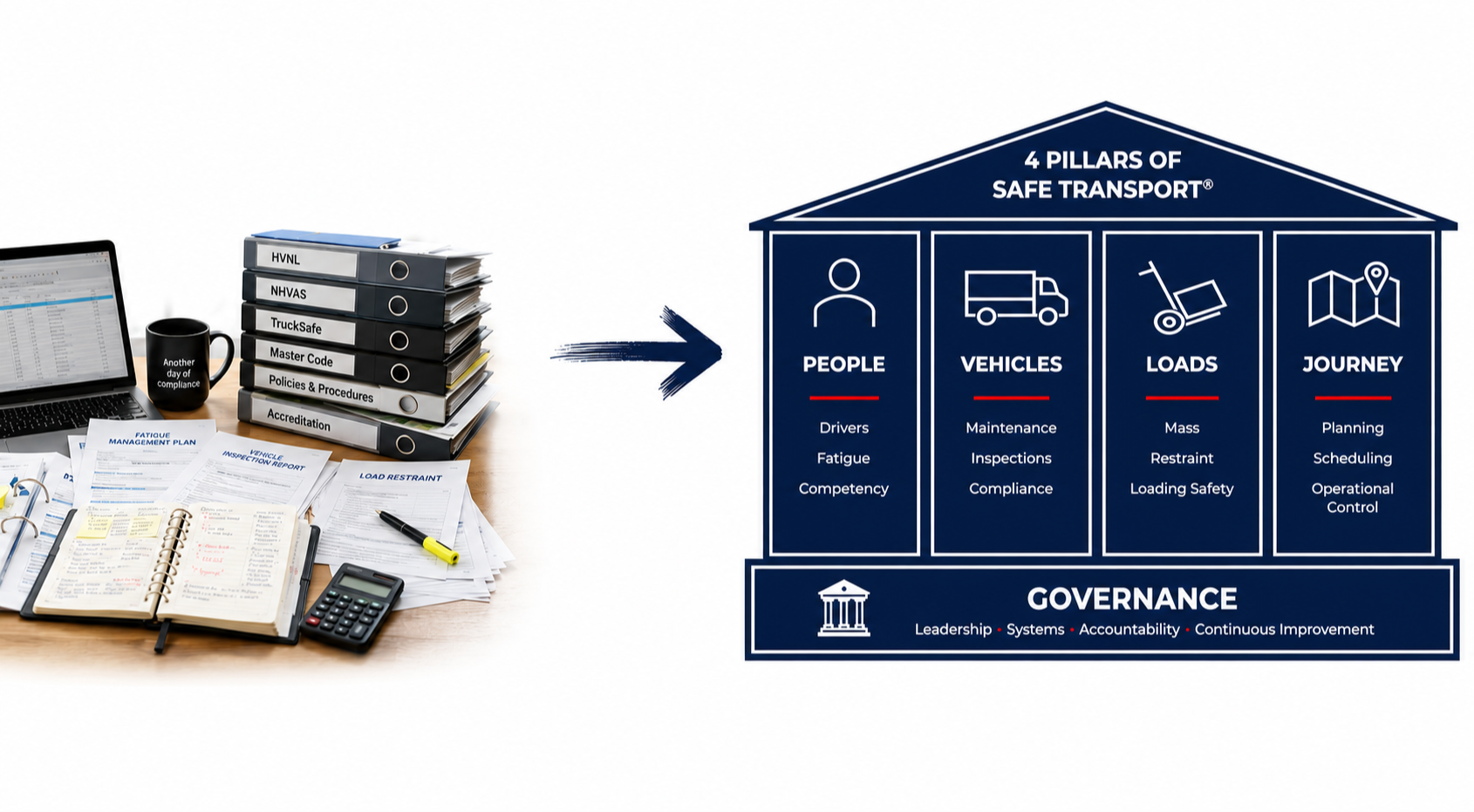
The 4 Pillars of Safe Transport® provides a simpler way to organise and manage compliance by aligning every requirement to four practical categories:
✓ Safe People
✓ Safe Vehicles
✓ Safe Loads
✓ Safe Journeys
This allows businesses to build a common language across the organisation, making compliance easier to understand, communicate and apply every day.
Every Chain of Responsibility obligation can be aligned to
one or more of the 4 Pillars.
GOVERNANCE:
The Foundation of Safe Transport
Every safe transport operation is built on more than drivers, vehicles and procedures. It is built on leadership, accountability and systems that support good decisions every day.
Leadership
Setting expectations, allocating resources and creating a culture where safety and compliance matter.
Systems
Policies, procedures, training, records and controls that support consistent operations.
Accountability
Clear responsibilities, ownership of actions and follow-through when issues are identified.
Continuous Improvement
Learning from incidents, audits, reviews and operational experience to continually improve performance.

Governance is not a fifth pillar.
It is the foundation that supports every pillar.
PEOPLE:
The People We Rely On Every Day
Every transport operation relies on people.
From directors and managers through to schedulers, loaders, drivers and subcontractors, the decisions people make every day influence safety, compliance and business performance.
Strong people management is about more than simply employing drivers. It is about ensuring people have the skills, support, resources and confidence they need to perform their roles safely and effectively.
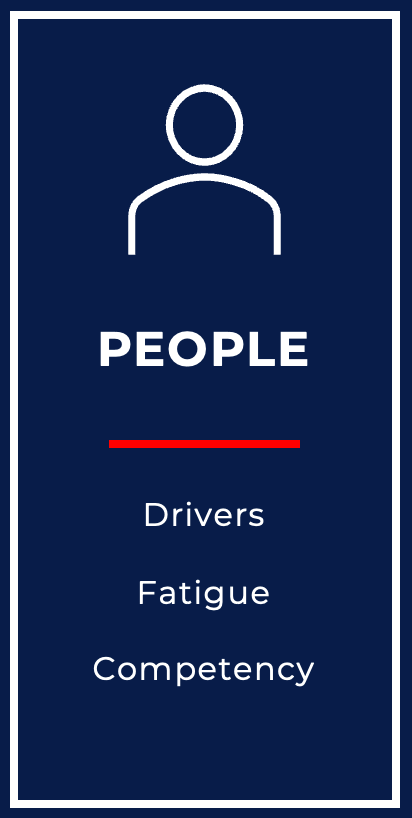
This pillar focuses on:
✓ Recruitment and onboarding
✓ Training and competency
✓ Fatigue and fitness for duty
✓ Communication and consultation
✓ Supervision and accountability
✓ Safety culture and behaviour
Safe people are more than drivers with a pulse.
They are people who have the skills, support and confidence to make good decisions every day.
VEHICLES:
The Vehicles Driving Your Business.
Every transport business relies on vehicles to deliver for its customers, generate revenue and keep operations moving.
Whether it's a light rigid running around town or a road train navigating the outback, safe and reliable assets are essential to operational success.
A well-managed vehicle not only reduces the risk of incidents and breakdowns, but also improves reliability, efficiency and customer confidence.
Strong vehicle management goes beyond servicing and repairs. It includes selecting the right vehicle for the task, maintaining critical safety systems, managing faults and ensuring compliance with legislative and manufacturer requirements throughout the asset's lifecycle.
This pillar focuses on:
✓ Vehicle selection and suitability
✓ Inspection, servicing and maintenance
✓ Fault reporting and rectification
✓ Roadworthiness and compliance
✓ Asset lifecycle management
✓ Safety technology and equipment
✓ Registration, accreditation and statutory requirements
Safe vehicles are more than trucks that start each morning.
They are vehicles that remain fit for purpose throughout their operational life.
LOADS:
The Loads Moving Our Country
Every day, millions of tonnes of freight move across Australia.
From food and fuel to machinery, livestock and consumer goods, transport plays a critical role in keeping communities supplied and businesses operating. Managing that load safely protects people, vehicles, customers and the reputation of the business.
Strong load management is about more than securing freight before departure. It includes understanding load characteristics, vehicle suitability, weight distribution, loading methods and the risks associated with loading and unloading activities.
Poor load management can result in injuries, vehicle instability, load shifts, damaged freight, regulatory breaches and serious incidents on the road or at customer sites.
This pillar focuses on:
✓ Load planning and preparation
✓ Mass, dimension and loading limits
✓ Load restraint and securement
✓ Vehicle and load compatibility
✓ Loading and unloading safety
✓ Dangerous goods and specialised freight
✓ Customer and site-specific requirements
Safe loads are more than good DIFOT.
They are loads that are planned, loaded, restrained and managed safely from start to finish.
JOURNEYS:
The Journeys That Bring You Home.
Every transport task begins with a destination, but the most important outcome is getting people home safely.
Whether travelling across town or across the country, the way a journey is planned, monitored and managed has a direct impact on safety, compliance and operational performance.
Strong journey management is about more than simply assigning a driver and a destination. It includes understanding the risks associated with the route, the task, the vehicle, the load and the people involved.
Effective journey planning helps businesses manage fatigue, scheduling pressures, changing conditions, customer expectations and unforeseen events that can occur along the way.
When journeys are properly planned and supported, operators are better equipped to make safe decisions, respond to changing circumstances and complete the transport task successfully.
This pillar focuses on:
✓ Route planning and risk assessment
✓ Scheduling and time management
✓ Fatigue and fitness for work
✓ Speed management
✓ Permits and regulatory requirements
✓ Communication and operational control
✓ Monitoring and responding to changing conditions
Safe journeys are more than getting from A to B.
They are journeys that are planned, monitored and managed to reduce risk along the way.
SAFE TRANSPORT IS MORE THAN COMPLIANCE
Every transport task involves people, vehicles, loads and journeys.
When these elements are managed in isolation, risks are often missed, compliance becomes complex and safety performance suffers.
The 4 Pillars of Safe Transport® brings these elements together within a practical framework. It is supported by strong governance, which helps businesses identify risk earlier, simplify compliance and build safer, more resilient transport operations.
PEOPLE. VEHICLES. LOADS. JOURNEYS
Connected through strong Governance.
Want Help Applying The 4 Pillars?
The 4 Pillars of Safe Transport® provides a practical framework for managing transport risk. If you'd like help applying the framework within your operation, contact us for a no-obligation discussion.